
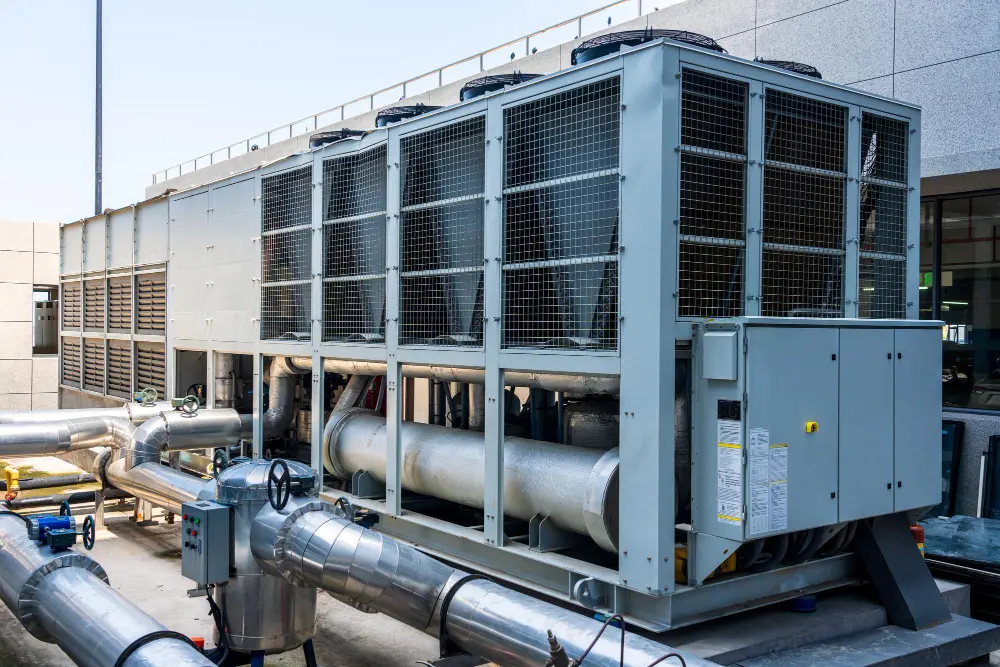
If your building is cooled by a chiller plant, the water moving through its pipes and coils needs as much care as the machines. The right chilled water treatment chemicals, applied properly, help protect that circuit against corrosion, deposits and microbial problems.
This guide explains how chilled water treatment works, how it differs from treating an open cooling tower, what a typical treatment procedure involves, and what to weigh up when choosing products for a UAE facility.
Closed Chilled Water Loops vs Open Cooling Water Circuits
A water-cooled chiller plant usually runs two separate water circuits, and they behave very differently.
- The chilled water loop is closed. Water circulates between the chiller’s evaporator and the building’s air handling units or fan coil units, picks up heat and returns. Because it is sealed, it should need little makeup water in normal operation.
- The condenser water loop is open. It carries heat from the chiller to a cooling tower, where some of the water evaporates. As it evaporates, dissolved solids become more concentrated, so part of the water is drained off (blowdown) and replaced with fresh makeup water.
Air-cooled chillers reject heat directly to the air, so they only have the closed chilled water side.
A closed loop still needs attention. Steel and copper in the system can corrode, and the ASHRAE (American Society of Heating, Refrigerating and Air-Conditioning Engineers) Handbook chapter on water treatment notes that mud, rust and silt can deposit in closed-loop piping. It also notes that hydronic systems running below about 50°C provide conditions for microorganisms to grow, and chilled water runs well below that.
Types of Chilled Water Treatment Chemicals and What They Do
The chilled water treatment chemicals used in a closed loop fall into a few broad groups. Which ones a system needs depends on its metals, its water chemistry and its current condition.
Corrosion Inhibitors
These protect metal surfaces from attack. ASHRAE describes nitrites and molybdates as passivating inhibitors, meaning they help maintain a protective film on the metal, and points out that molybdate needs oxygen to work effectively. Azoles are a class of inhibitor used to protect copper.
Biocides
Biocides control bacteria and other microorganisms. Whether a closed loop needs one, and which type, should be decided from test results rather than habit.
Dispersants
Dispersants help keep fine particles such as rust and silt suspended in the water, so they can be removed by filtration instead of settling in pipes, coils and strainers.
Chilled Water Chemical Treatment Procedure: Step by Step
No single procedure suits every building, but a sound chilled water chemical treatment procedure usually follows the same logic:
- Assess the system. Record the system volume, the metals present, its age, the makeup water source and any history of leaks or past problems. Check the equipment manufacturer’s guidance.
- Test the water. A baseline analysis shows the current chemistry, any existing inhibitor levels and signs of contamination.
- Clean if needed. If inspection or testing reveals heavy deposits or contamination, the loop may need cleaning or flushing before a new programme starts.
- Choose a treatment programme. Match the chemicals to the metals and the water. A loop containing copper, for example, needs protection suitable for copper.
- Dose correctly. Follow the product instructions and base the dose on the system’s volume and test results.
- Monitor and adjust. Test regularly, compare results with the targets set for that programme, and record every reading and addition.
Dose rates, target ranges and testing intervals should come from the product supplier, the equipment manufacturer and a qualified water treatment specialist, not from a generic chart.
Cooling Water Treatment Methods and How They Differ
Many cooling water treatment methods were developed for open systems such as cooling towers, and some have no place in a sealed chilled water loop.
| Method | Open cooling tower | Closed chilled water loop |
| Blowdown to control dissolved solids | A core method, because evaporation concentrates solids | Not normally used, as there is no evaporation |
| Corrosion and scale inhibitors | Used | Corrosion inhibitors chosen for the metals in the loop |
| Biocides | Central to most programmes | Used where testing shows a need |
| Filtration | Used to reduce suspended solids | Can help remove rust and silt |
ASHRAE goes as far as saying that more cooling water treatment programmes fail through poor microbiological control than through any other treatment problem, which is why towers get so much attention.
The open side matters for the chiller too. A technical paper from the Association of Water Technologies (AWT) notes that enhanced chiller tubes are more vulnerable to scale than straight-bore tubes. For more on treating the open circuit, see our article on cooling tower chemicals.
Common Water Quality Problems in Chilled Water Systems
- Corrosion. Metal loss can lead to leaks and releases rust particles into the loop.
- Deposits and sludge. Rust, mud and silt can settle in low-flow areas, coils and strainers.
- Microbial growth. Bacteria can form biofilm on internal surfaces and contribute to corrosion.
- Contamination. Poor makeup water, or a failed heat exchanger tube that lets open and closed water mix, can upset the loop’s chemistry.
- Inhibitor loss. Every time water is lost and topped up, the treatment is diluted.
Monitoring, Testing and Keeping Records
A treatment programme is only as good as its follow-up. Regular testing confirms that inhibitor levels are where they should be and catches changes early.
ASHRAE describes corrosion coupons, small metal samples placed in the water flow, as an accepted way to evaluate corrosion rates in both closed and open systems.
Records matter as much as the tests themselves. Keep a log of results, chemical additions and makeup water use. A sudden rise in makeup water is often the first sign of a leak. Our cooling water treatment chemicals guide covers the wider role of treatment chemicals in cooling systems.
Selecting Suitable Treatment Chemicals for UAE Cooling Systems
Before choosing products, consider:
- Whether the circuit is a closed chilled water loop or an open condenser loop
- The metals in the system, including steel, copper and any other alloys
- The source and quality of the makeup water
- Operating conditions and the equipment manufacturer’s guidance
- Compatibility with chemicals already in the loop
Ask for clear product information and safety data sheets. Working with a cooling water treatment supplier in uae that can explain what a product contains and how it should be applied makes it easier to match treatment to your system.
How Chemway Chemicals Can Support Your Water Treatment Needs
Founded in 2018, chemway chemicals is a Dubai-based chemical supplier and distributor with a distribution centre in Sharjah. Its cooling water treatment product combines corrosion inhibitors, dispersants and biocides for cooling towers, chillers and other cooling systems, and the company lists water treatment among its services.
As with any product, confirm with the supplier and a qualified specialist that it suits your specific circuit. To discuss your system and request product details, contact the Chemway team.
Conclusion
Closed chilled water loops and open cooling towers face different risks, so they need different treatment. Choose chilled water treatment chemicals based on your system’s metals and test results, follow a clear procedure, and keep monitoring and records up to date. That gives your cooling plant the best footing for reliable operation.
Frequently Asked Questions
1. What do chilled water treatment chemicals actually do?
They help protect a closed loop from corrosion, deposits and microbial growth. Corrosion inhibitors protect metal surfaces, dispersants keep particles suspended, and biocides control microorganisms. The right combination depends on the system’s metals, water chemistry and test results.
2. How often should a chilled water chemical treatment procedure be reviewed?
There is no fixed interval for every building. Review the programme when test results move outside agreed targets, after repairs or large water losses, and as part of the routine monitoring set by your water treatment specialist.
3. Can cooling water treatment methods for towers be used in a chilled water loop?
Not directly. Methods such as blowdown exist because cooling towers lose water through evaporation, which concentrates dissolved solids. A sealed chilled water loop works differently, so its treatment should suit closed-system conditions and the materials in the loop.
4. Why does makeup water use matter in a closed chilled water system?
A sealed loop should need little makeup water. Frequent top-ups can point to a leak, and each addition dilutes the chilled water treatment chemicals and brings in fresh water, so tracking makeup volume helps you spot problems early.
5. What water tests are important for chilled water system maintenance?
Common checks include pH, conductivity, inhibitor levels and signs of corrosion, depending on the treatment programme. Testing helps confirm whether the water chemistry remains within the specialist’s target range and whether treatment adjustments or further investigation are needed.
